
Striving for Aretē
Athletic competitions were a way for athletes to achieve aretē, a socio-cultural concept encompassing excellence and moral and physical virtue. Aretē fit within the broader context of ancient Greek competitive spirit that consisted of struggle (agōn), notably present in warfare and athletics, where one gains victory over their opponent. Not every citizen competed in athletic competitions but those who did, and reined victorious, would achieve aretē and receive a prize and kleos (fame and glory). Athletic competitions and games, such as the Greater Panathenaia as seen in this display, took place at religious festivals which honoured the gods.
Competition Scenes
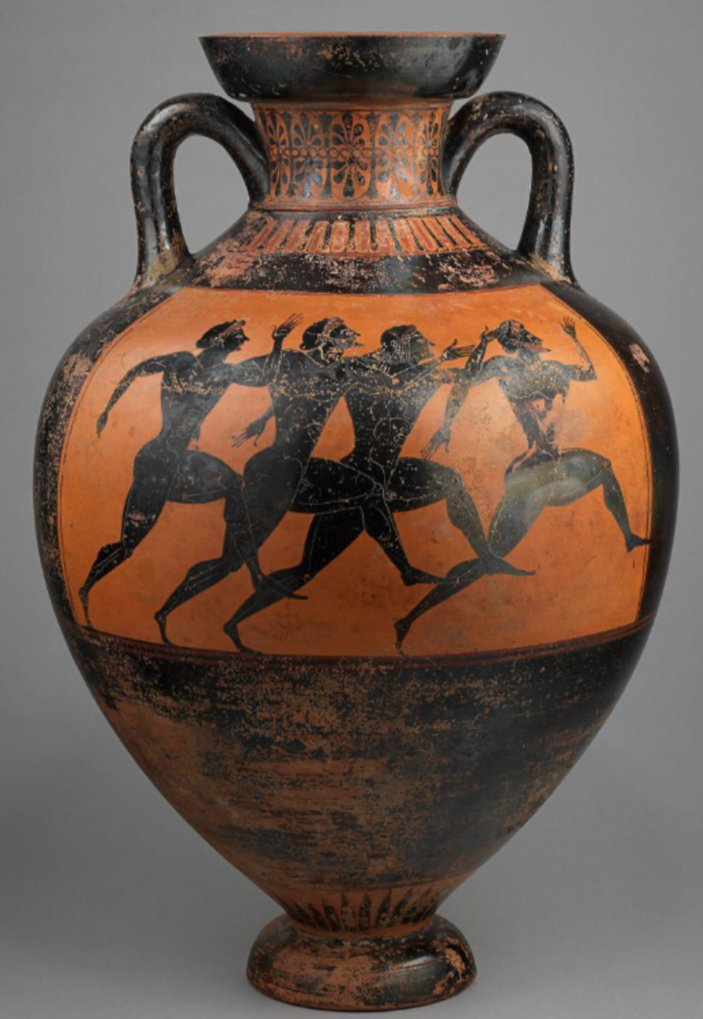
Photo courtesy of the ROM
Pseudo-panathenaic amphora with foot race, 525-475 BCE
Artist Once Known
Athens
Black-figure technique
Athletes compete in a footrace, likely a sprint because of the way they fling their arms in front and behind their bodies. The athletes’ bodies denote swiftness with long strides: their left leg extends into the air while their right foot brushes the ground with heel raised. The close positioning of their bodies show a suspenseful, dynamic moment.
Royal Ontario Museum 915.24
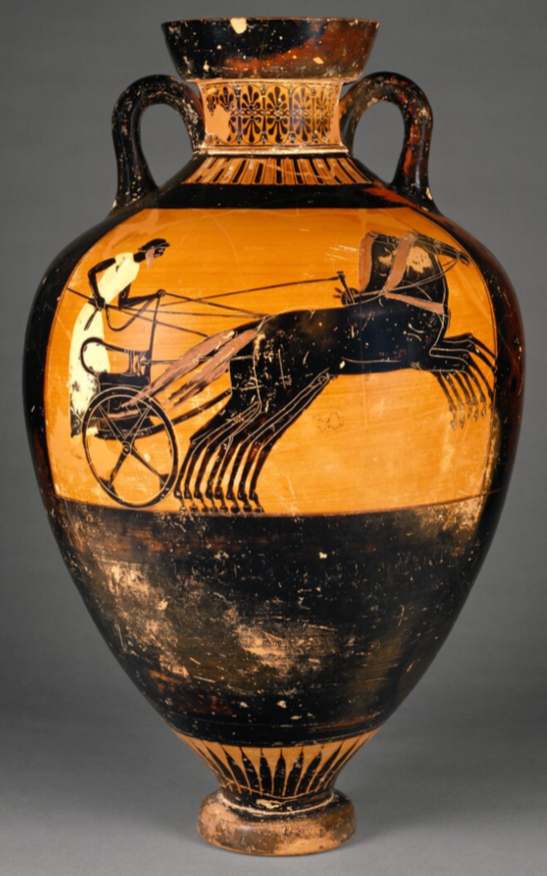
Photo courtesy of The Getty Museum
Panathenaic amphora with chariot race, 525-475 BCE
Credited to the Kleophrades Painter
Attica (district encompassing Athens)
Black-figure technique
The eye is drawn immediately to the charioteer whose chiton (clothing) is painted white. Holding the horse’s reins, the charioteer urges the horses, who balance on their back legs, forward in an effort to win the race. Chariot racing was highly prestigious as was the festival this vessel was made for, the Panathenaic Games.
Getty 77.AE.9
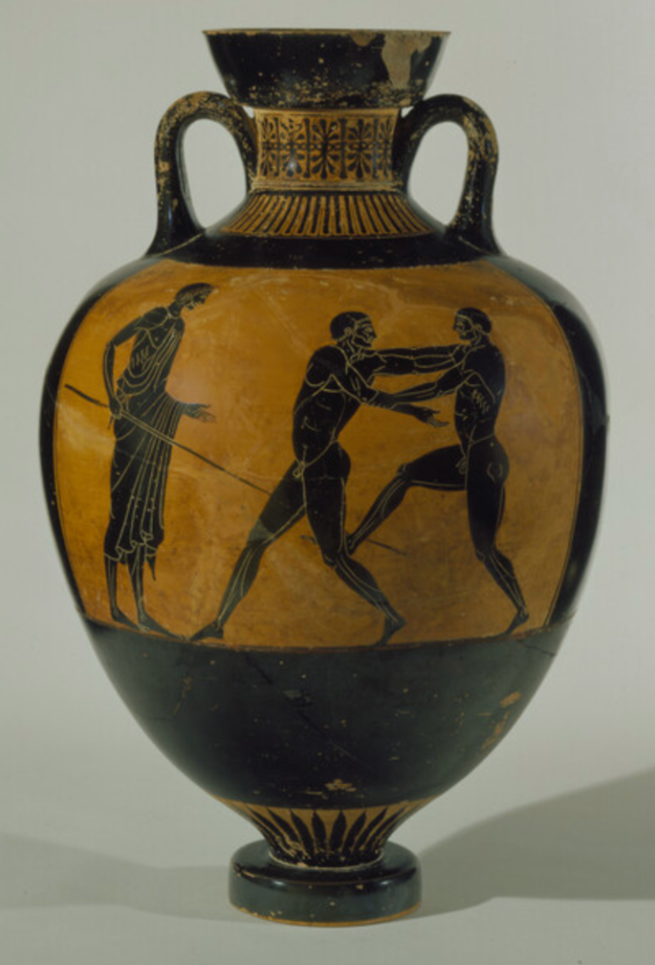
Photo courtesy of The Hood Museum
Hydria (water vessel) with athletes and horseriders, about 500 BCE
Credited to the Leagros Group (artist guild)
Attica (district encompassing Athens)
Black-figure technique
The figures in the main scene on the vessel are inscribed: the named horseriders are called kalos (beautiful and virtuous) and the horses are called Thrasos (courage) and Aretē (excellence). Kalos, Thrasos, and Aretē are descriptors which can be applied to the figures occupying the space above which consist of youthful athletes competing and training in boxing and running.
Vatican Museo Gregoriano Etrusco 416
Want to learn more? View the complete catalogue record below.
Panathenaic amphora with wrestlers, 480-470 BCE
Credited to the Berlin Painter
Attica (district encompassing Athens)
Black-figure technique
Two bearded athletes wrestle while a clothed trainer, holding a stick, looks on and gives feedback. The wrestlers look to be nearing the end of the fight with the athlete on the right with the upper hand. The right athlete kicks the back of his opponent’s knee who twists his body around and is in a precarious position.
Hood Museum C.959.53
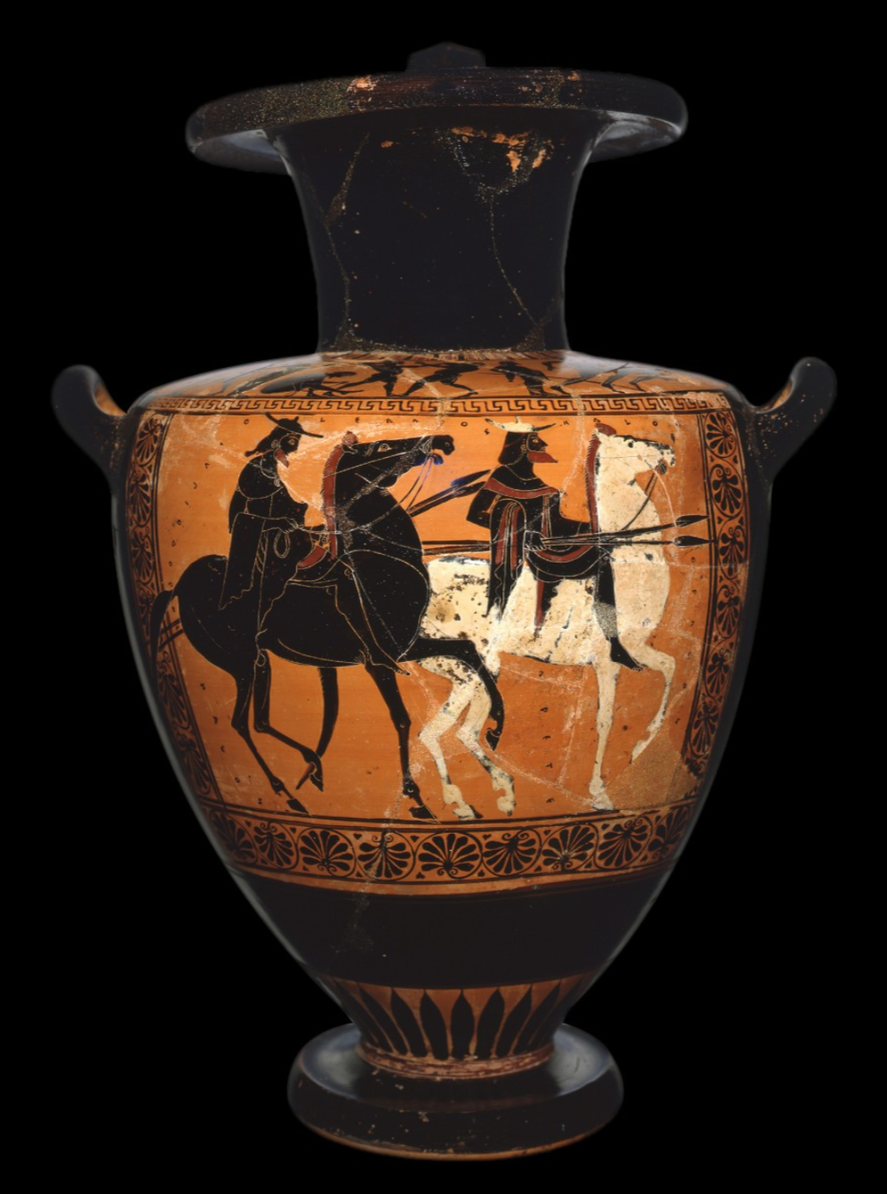
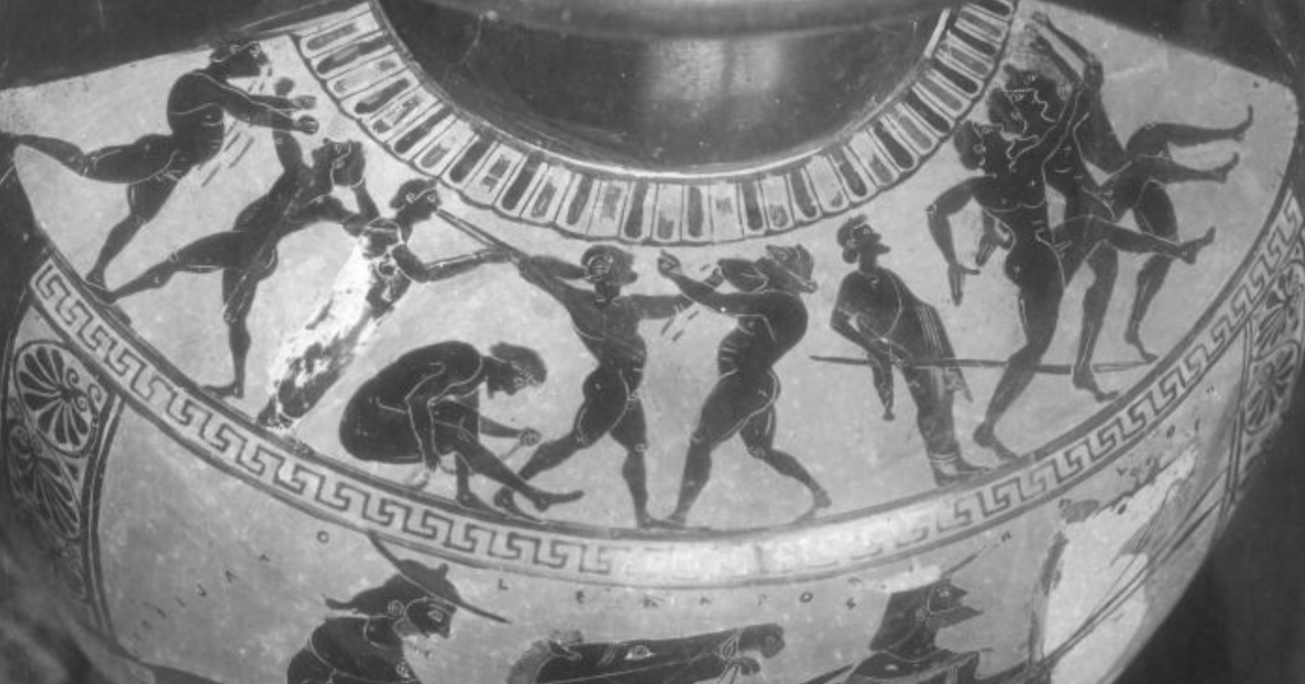
Photo courtesy of the Vatican
Photo courtesy of the Beazley Archive
-
This Attic black-figure pseudo-panathenaic amphora is dated from 525 to 500 BCE and is not attributed. It is currently located at the Royal Ontario Museum and was a gift of Sir Alfred Mond; the object number is 915.24. The amphora is 62.2 cm in height and 41.6 cm in diameter. It is a “pseudo” amphora because it does not have the typical inscription for Panathenaic prize vases given to the winner of the Panathenaic Games. The amphora is in the style of a Panathenaic vase as it depicts Athena Promachos on one side and an athletic scene on the other. Athena is depicted with her typical attributes with a scale pattern aegis which contrasts with the long lines of her flowy skirt. She wears a plumed helmet that extends into the ovolo pattern motif on the neck of the amphora. She carries a shield though the design is unclear as it has been flaked off. Athena is bordered by two roosters sitting upon columns. Athena’s exposed skin (face, arms, feet) is painted white. Red paint is added on the perimeter of her shield, part of her helmet, throughout her dress, and on the roosters’ combs and feathers. On the reverse side of the amphora is a footrace with four runners, two bearded, two not. The runners’ beards are painted red as is the front of their hair. The four runners’ bottom halves are in right profile with their torso slightly frontal, perhaps a decision by the artist to show off the athletes’ kalos (beauty). The athletes have their left legs extended off the ground which overlap with one another; the strides are long. The athletes’ back right legs, with a lifted heel, ground their movement showing swiftness and ephemerality. Their left arms are extended in front of their body with their back right arms trailing behind giving a semblance of balance and symmetry. The arms spread in such a manner in addition to the long strides suggests this is a short-distance race. The bearded runner in the lead pulls slightly ahead as seen in the negative space between him and the figures immediately behind him, though it is a close race. There is a ray pattern on the foot.
_
Beazley Archive Pottery Database. n.d. “5997, ATHENIAN, Toronto, Royal Ontario Museum, 915.24.” Accessed March 20, 2026. https://www.carc.ox.ac.uk/XDB/ASP/recordDetails.asp?id={B873B05F-8DAC-4515-8279-258FC78DF029}&noResults=6&recordCount=1&databaseID={12FC52A7-0E32-4A81-9FFA-C8C6CF430677}&search={AND}%20%20[Collection%20Name]%20Toronto,%20Royal%20Ontario%20Museum%20{AND}%20%20[Decoration%20Termword]%20ATHLETES.
Corpus Vasorum Antiquorum. 1981. “TORONTO, ROYAL ONTARIO MUSEUM, 16, PL.(22) 22.1-2.” Accessed March 20, 2026. https://www.carc.ox.ac.uk/XDB/ASP/browseCVARecord.asp?id={B873B05F-8DAC-4515-8279-258FC78DF029}&startRef=&x=1&newwindow=true.
Neils, Jenifer. “Picturing Victory: Representation of Sport in Ancient Greek Art.” In A Companion to Sport and Spectacle in Greek and Roman Antiquity, edited by Paul Christesen and Donald Kyle. West Sussex: Wiley-Blackwell, 2014.
Royal Ontario Museum. n.d. “Attic black-figure Panathenaic amphora showing Athena Promachos and athletes in a foot race.” Accessed March 20, 2026. https://collections.rom.on.ca/objects/343477/attic-blackfigure-panathenaic-amphora-showing-athena-promac.
-
This Attic black-figure Panathenaic amphora is dated from 500 to 480 BCE and is attributed to the Kleophrades Painter by John Beazley. It is currently located at the Getty Museum and was acquired in 1977 through a donation by Nicolas Koutoulakis from Geneva, Switzerland; the object number is 77.AE.9. The amphora is 65 cm in height and 40.3 cm in diameter. Typical of Panathenaic amphorae decoration, this vase depicts Athena Promachos on one side and an athletic competition on the other. The Athena Promachos pose looks as though she is striding into battle, seen in her posture and raised left heel showing swift movement. She is bordered by two columns, the left of which is inscribed vertically with “of the prizes from Athens,” a standard among Panathenaic amphorae. Athena is depicted with her typical attributes of a plumed helmet, shield, and spear. The folds of Athena’s dress have a bit of volume, movement, and flow with the hemline responding to her leg positioning. She is in left profile with her left arm extended to head height, holding a spear, and right arm holding a shield which protects the front of her body. Athena’s shield is decorated with Pegasos, its style typical of the Kleophrades Painter who is attributed as the artist. On the reverse, there is a four-horse-chariot race, one of the most prestigious competitions in the Panathenaiac Games. The charioteer is bearded and wears a chiton which is painted white. His arm musculature is on display showing the strength and control needed for the sport. The horses stand on their back feet with front feet in the air and tails trailing behind them showing movement and swiftness. The scenes on Side A and Side B are not centered on the amphora but rather located at the widest diameter of the vase giving more surface space. There is a fair amount of negative space between the scene and decorative motif on the bottom of the vase. There is a palmette and ovolo pattern motif on the neck; the feet have a ray pattern. The handle was repaired during ancient times.
_
Beazley Archive Pottery Database. n.d. “201789, ATHENIAN, Malibu (CA), The J. Paul Getty Museum, Switzerland, private, 77.AE.9.” Accessed March 20, 2026. https://www.carc.ox.ac.uk/XDB/ASP/recordDetails.asp?id={421DADD4-D09D-44FB-A02F-4BF5926E7B31}&noResults=21&recordCount=16&databaseID={12FC52A7-0E32-4A81-9FFA-C8C6CF430677}&search=%20{AND}%20%20[Collection%20Name]%20Malibu%20(CA),%20The%20J.%20Paul%20Getty%20Museum%20{AND}%20%20[Artist%20Name]%20KLEOPHRADES%20P.
The Getty. n.d. “Attic Panathenaic Amphora.” Accessed March 20, 2026. https://www.getty.edu/art/collection/object/103QSV.
-
This Attic black-figure Panathenaic amphora is dated from 480 to 470 BCE and is attributed to the Berlin Painter by Dietrich von Bothmer. It is currently located at the Hood Museum and was acquired in 1959 by gift of Mr. and Mrs. Ray Winfield Smith from New Hampshire; the object number is C.959.53. The amphora is 62.2 cm in height and 40.6 cm in diameter. On one side is Athena in the promachos pose with her shield decorated with the standard gorgoneion (gorgon head) meant to turn her opponents away when they gaze into the eyes of Medusa. While she is depicted in the typical Archaic style, her skirt is highly decorative. Athena is bordered by two columns upon which sit roosters, which were seen as aggressive animals in ancient Greece, at head height. Inscribed vertically on the right side of the left column is an inscription reading “ton Athenethen athlon” (from the games at Athens) certifying its status as a Panathenaic prize vase. On the other side of the amphora, two bearded wrestlers are in the heat of a fight, depicted alongside a trainer with a staff. The trainer’s staff, held in his right hand, overlaps the pair of wrestlers, perhaps fixing their technique or offering feedback to the athletes. The trainer’s left hand is extended out to the athletes further suggesting he is giving advice. The center wrestler’s bottom half faces the trainer whereas his torso twists toward the viewer, culminating in his head facing the other athlete who stands behind him and grapples with him. The athlete on the right is fully in left profile, facing his opponent, with his right leg kicking the other athlete’s back of the knee, taking advantage of his vulnerable positioning. The right athlete grabs the central athlete’s right arm. Both athletes have a raised left heel showing agility and a tense, precarious moment. Both athletes are lean with musculature throughout their bodies. On the neck of the amphora is a palmette and ovolo pattern motif; on the foot is a ray pattern.
_
Beazley Archive Pottery Database. n.d. “351283, ATHENIAN, Hanover (NH), Dartmouth College, C959.53.” Accessed March 20, 2026. https://www.carc.ox.ac.uk/XDB/ASP/recordDetails.asp?id={CEF8EF00-703D-49EC-9532-A8B467B4D11F}&noResults=1&recordCount=1&databaseID={12FC52A7-0E32-4A81-9FFA-C8C6CF430677}&search=%20{AND}%20%20[Collection%20Name]%20Hanover%20(NH),%20Dartmouth%20College%20{AND}%20%20[Artist%20Name]%20BERLIN%20P.
Hood Museum. n.d. “Black-figure Panathenaic prize amphora depicting Athena between columns (side a); Wrestlers and Judge with Staff (side b).” Accessed March 20, 2026. https://hoodmuseum.dartmouth.edu/objects/c.959.53.
Neils, Jenifer. “Picturing Victory: Representation of Sport in Ancient Greek Art.” In A Companion to Sport and Spectacle in Greek and Roman Antiquity, edited by Paul Christesen and Donald Kyle. West Sussex: Wiley-Blackwell, 2014.
-
This Attic black-figure hydria is dated about 500 BCE and is attributed to the Leagros Group by Ernst Buschor. It is currently located at the Vatican Museo Gregoriano Etrusco and was excavated in Cerveteri, Etruria in 1832; the object number is 416. The hydria is 58.2 cm in height and 25.2 cm in diameter. The main scene depicts two bearded men dressed in Thessalian costume and pétasos (travelling hat), holding two spears. The men are inscribed with “Olympiodoros kalos” and “Leagros kalos.” The men sit atop two named horses, Thrasos and Arete (courage and virtue/excellence), one painted white, one painted black. Added red paint is located on the horse’s manes, the men’s beards, and throughout their garments. The hydria’s shoulder depicts youthful athletes in a variety of sports including (from left to right): a pair of boxers; a clothed pipe player; seated athlete with a fillet or cæstus (boxing glove bandage); another set of boxers; a clothed judge (or trainer) with staff; and three runners in a sequential pattern. As opposed to the boxers, the runners are rendered with more slender bodies and well-defined musculature alluding to the sport for which they compete. Both sets of boxers look to be leaning back from their opponents with chins raised to avoid a strike to the head. Both sets of boxers have movement lines denoting swift punches and the pathway of the arms. The horsemen and athletes are connected by their kalos (beauty); whereas the horsemen have direct kalos inscriptions, it is implied the athletes share this trait. The horsemen are bearded and clothed but the athletes are not showing a contrast in not just activity but also age. The two scenes could show different aspects of elite men, sports and warfare, perhaps serving as a before and after but showing athletic prowess throughout. There is an ovolo pattern above the athletic scene on the shoulder; between the athletic and horse scene is a meander pattern motif; the horse scene is boarded by a palmette pattern on either side and underneath; another ovolo pattern is depicted on the bottom.
_
Beazley Archive Pottery Database. n.d. “302060, ATHENIAN, Vatican City, Museo Gregoriano Etrusco Vaticano, Vatican City, Museo Gregoriano Etrusco Vaticano, 16450.” Accessed March 20, 2026. https://www.carc.ox.ac.uk/XDB/ASP/recordDetails.asp?id={A2898B77-0033-4342-AB49-6BD0C946A4BF}&noResults=16&recordCount=4&databaseID={12FC52A7-0E32-4A81-9FFA-C8C6CF430677}&search={AND}%20%20[Collection%20Name]%20Vatican%20City,%20Museo%20Gregoriano%20Etrusco%20Vaticano%20{AND}%20%20[Artist%20Name]%20LEAGROS%20GROUP.
Musei Vaticani. n.d. “Attic Hydria of the Leagros Group.” Accessed March 20, 2026. https://www.museivaticani.va/content/museivaticani/en/collezioni/musei/museo-gregoriano-etrusco/sala-xix--emiciclo-inferiore--collezione-dei-vasi--ceramica-atti/hydria-attica-del-gruppo-di-leagros.html.