
Cult of the Athlete
Successful athletes transcended their station and were elevated from their counterparts. Some athletes attained a cult following where their kleos (fame and glory) was represented across the visual and literary arts celebrating their aretē (excellence, virtue) and cementing their legacy. Successful athletes obtained a heroic status in that they were worshipped and received similar honours including a cult following and heavy presence in the arts. Athletes named on pottery give inclinations to the clout of these idol figures commemorating their specific achievements in sport of their exceptional beauty.
Success Scenes
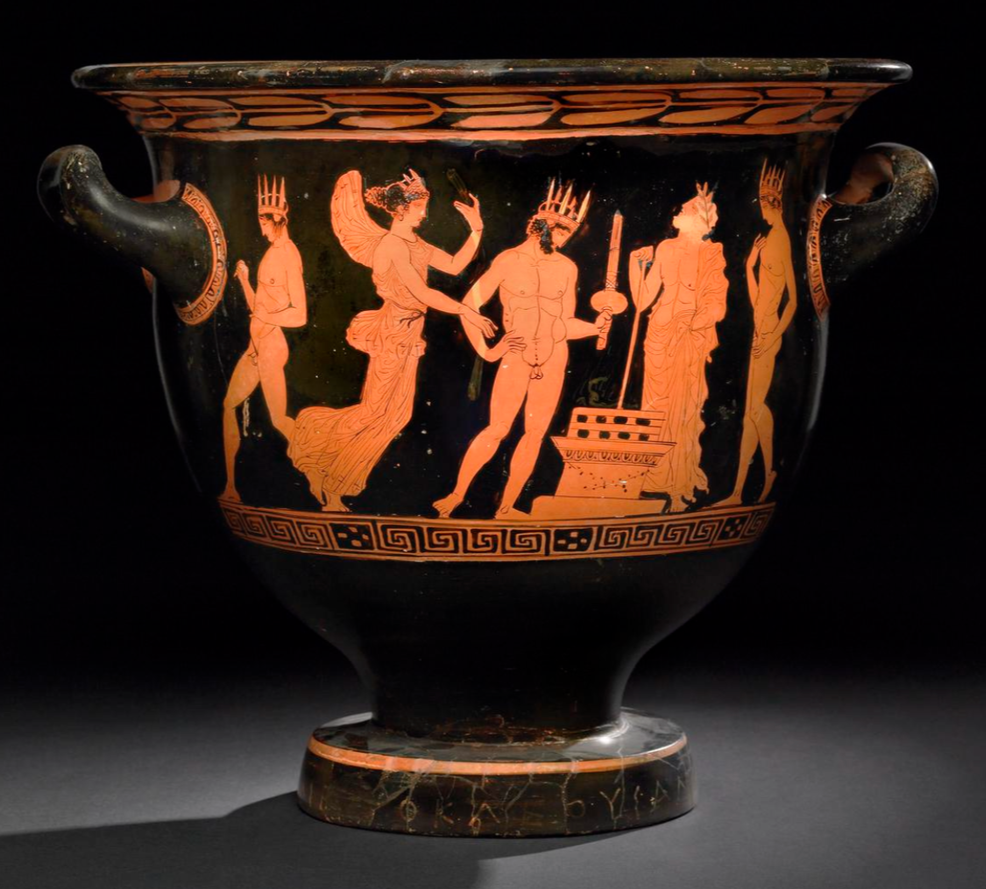
Photo courtesy of the British Museum
Krater with crowning scene, 420-400 BCE
Signed by the Nikias Painter
Attica (district encompassing Athens)
Red-figure technique
Nike, Goddess of Victory, flutters down toward the central figure and ties a fillet (fabric piece) around his arm, signalling the athlete’s victory. The victor wears a crown, typical of torch race competitors, and stands before an altar. Inscribed on the victor’s crown is the name of his tribe, Antiochis, which the elder man on the right prepares to announce with mouth agape.
British Museum 1898, 0716.6
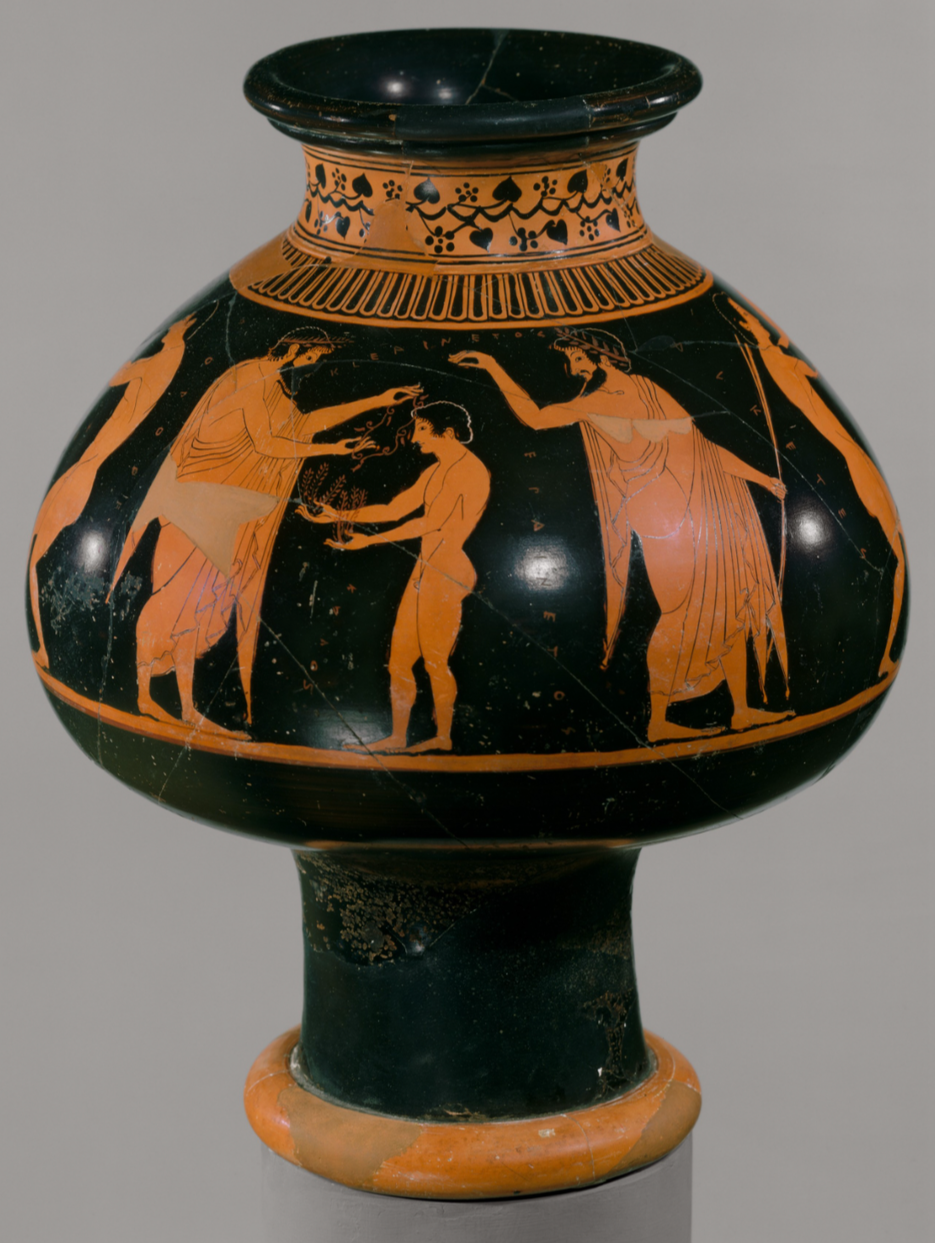
Photo courtesy of the MET
Psykter (vase for cooling wine) with crowning and athletes, 520-510 BCE
Credited to the Oltos Painter
Attica (district encompassing Athens)
Red-figure technique
A youthful athlete, Epainetos, is crowned by a bearded judge and accompanied by his trainer. Epainetos is celebrated in his victory and for his beauty seen with the kalos (beautiful, virtuous) inscription. The athletes surrounding the crowning scene are also named alongside this scene of victory showing they are also reputable, successful athletes occupying the same space.
Metropolitan Museum of Art 10.210.18
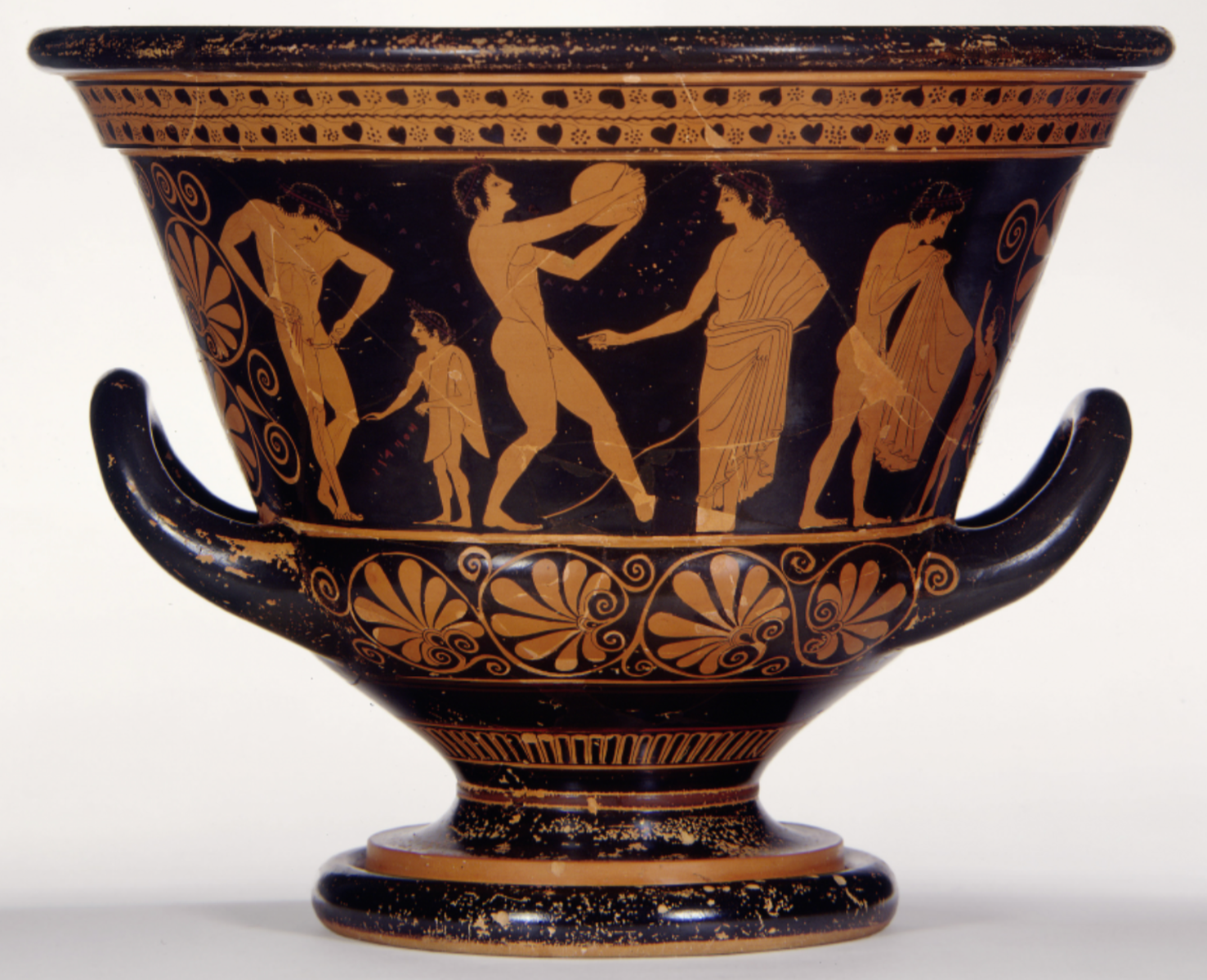
Photo courtesy of the Staatliche Museen zu Berlin
Lekythos with named athletes engaged in pentathlon training, about 500 BCE
Credited to the Kephisophon Painter
Athens
Black-figure and white-ground (white clay slip) techniques
Likely used to hold an athlete’s body oil, this lekythos depicts five naked athletes each engaged in pentathlon training (boxing, jumping, discus, running, javelin) as evidenced by their equipment. The athletes are named, connecting their athletic prowess with a specific pentathlon sport and associated success. No longer in need of a trainer, the athletes practice on their own.
Royal Ontario Museum 963.59
Want to learn more? View the complete catalogue record below.
Calyx-krater (vase for mixing wine) with named athletes training and preparing, 550-500 BCE
Credited to the Euphronios Painter
Attica (district encompassing Athens)
Red-figure technique
Five named athletes get ready for a competition; beside their names reads “kalos.” Four athletes prepare their bodies by pouring oil over their skin from an oil container, binding their genitals (infibulation), and undressing. The fifth athlete is ready to compete and holds a discus. Trainers and slaves accompany the athletes showing they are being tended to as their beauty and status warrants.
Staatliche Museen zu Berlin Antikensammlung F2180
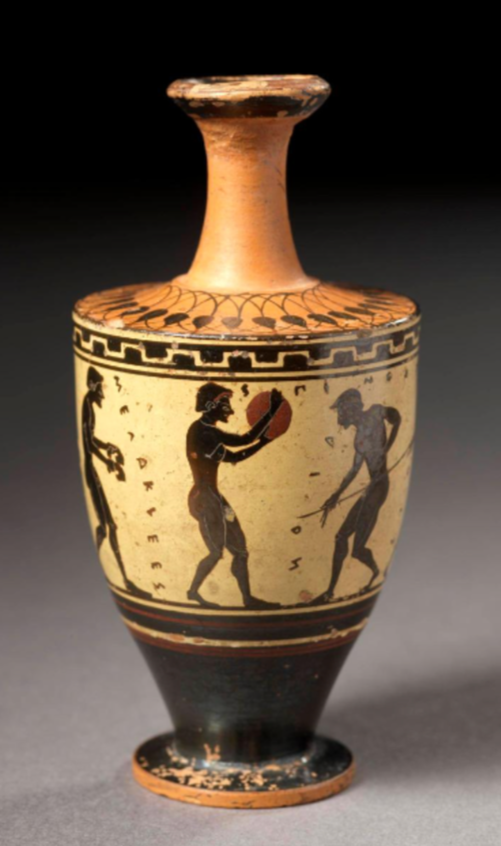
Photo courtesy of the ROM
-
This Attic red-figure krater is dated from 420 to 400 BCE and is attributed to the Nikias Painter by signature. It is currently located at the British Museum and was acquired in 1898 through purchase by Count Michel Tyszkiewicz; the object number is 1898, 0716.6. The krater is 37.45 cm in height. The findspot was Greece, likely at the gravespot of the commissioner tribe called Antiochis. On Side A, the scene depicts five figures on one ground line. On the outsides of the scene are two naked, crowned athletes: the leftmost facing away and the rightmost facing inward. The leftmost athlete hangs his head and looks to be walking away from the rest of the figures, perhaps too sad to gaze upon the crowning of the victor. The second figure from the left is Nike, Goddess of Victory, wings aloft. She faces the central bearded, naked figure who is crowned and looks away from her toward an altar. Nike is in the process of tying a fillet on the left arm of the victor grasping his right arm in hers. The emphasis of the composition is on the winner as the central figure standing at the altar who is celebrated by Nike and the figure to the right. The fourth figure from the left is an elder man with a staff, perhaps Prometheus, who wears a leaf wreath and is clothed. The elder’s head faces upward with his mouth open, perhaps announcing the winning tribe name. On the crowns of the athletes, typically worn by torch race competitors, sit their inscribed tribe names. The scene depicts a specific tribal crowning with the victor (central figure) bringing glory to his tribe, Antiochis, which existed under Kleisthenes’s democratic rule in ancient Athens. Because of the rarity of this scene with specific tribes named, the tribe may have commissioned this krater. Side B consists of three heavily-draped youths, two with staffs, one with a strigil, and suspended halteres (jumping weights) in the background. There is a leaf motif surrounding the top of the krater and a meander pattern on the bottom. On the foot of the krater is the artist’s signature Nikias, son of Hermokles, and his deme of Anaphlystos.
_
Beazley Archive Pottery Database. n.d. “217462, ATHENIAN, London, British Museum, London, British Museum, 1898,0716.6.” Accessed March 20, 2026. https://www.carc.ox.ac.uk/XDB/ASP/recordDetails.asp?id={6572A182-6922-474D-B2B8-FA76D64CFD82}&noResults=4&recordCount=1&databaseID={12FC52A7-0E32-4A81-9FFA-C8C6CF430677}&search=%20{AND}%20%20[Collection%20Name]%20London,%20British%20Museum%20{AND}%20%20[Artist%20Name]%20NIKIAS%20P.
British Museum. n.d. “Krater.” Accessed March 20, 2026. https://www.britishmuseum.org/collection/object/G_1898-0716-6.
Neils, Jenifer. “Picturing Victory: Representation of Sport in Ancient Greek Art.” In A Companion to Sport and Spectacle in Greek and Roman Antiquity, edited by Paul Christesen and Donald Kyle. West Sussex: Wiley-Blackwell, 2014.
-
This Attic red-figure psykter (vase for cooling wine) is dated from 520 to 510 BCE and is attributed to the Oltos Painter by John Beazley. It is currently located at the Metropolitan Museum of Art and was acquired in 1910 by the Rogers Fund; the object number is 10.210.18. Previously, it was in Rome’s National Etruscan Museum of Villa Giulia. The psykter is 34.6 cm in height and 28 cm in diameter. The scene depicts a bearded judge, Kleainethos, crowning the youthful athlete, Epainetos (inscribed with Epainetos kalos), and his bearded trainer, Alketes. The trainer and judge are bearded and stand tall compared to the athlete who is more diminutive in size and not-bearded. Youthful athletes surround this threesome and practice their associated sports in the gymnasium. The figures are named by inscriptions citing Smikythos, the flute or pipes player (non-bearded); Antiphanes, the discus thrower (non-bearded) with his trainer, Antimenes; Dorotheos the jumper (non-bearded) with halteres (with an inscription saying “he is going to jump”; an uncommon meta commentary describing the scene); and Batrrachos the javelin thrower. Simultaneously, the scene depicts training and a crowning perhaps signalling the fact the athletes are depicted in the same space but at different times. The fact these athletes are named point to their position in society alluding to a real-life event where they were celebrated. There is an ivy motif around the top of the psykter and an ovolo pattern immediately below. Two inscriptions speak to the vase shape and function: “drink me” and “I open my mouth wide.” These instructions point to the function of this vase as used in symposia as a jest or nod to the drinkers who would heed this advice. The inscriptions would have entertained the symposiasts while they simultaneously gaze upon the beauty of the athletes.
_
Beazley Archive Pottery Database. n.d. “200439, ATHENIAN, Rome, Mus. Naz. Etrusco di Villa Giulia, New York (N.Y.), Metropolitan Museum, 22643.” Accessed March 20, 2026. https://www.carc.ox.ac.uk/XDB/ASP/recordDetails.asp?id={5424F924-0F7B-48FA-95D9-8F5F172BFD37}&noResults=14&recordCount=1&databaseID={12FC52A7-0E32-4A81-9FFA-C8C6CF430677}&search={AND}%20%20[Collection%20Name]%20New%20York%20(N.Y.),%20Metropolitan%20Museum%20{AND}%20%20[Artist%20Name]%20OLTOS.
MET Museum. n.d. “Terracotta psykter (vase for cooling wine).” Accessed March 20, 2025. https://www.metmuseum.org/art/collection/search/248306.
Seungjung, Kim. “Gender - The Male World.” FAH2041: Greek Vases at the ROM. Class Lecture at the University of Toronto, Toronto, ON. February 25, 2026.
-
This Attic black-figure, white-ground lekythos is dated about 500 BCE and attributed to the Kephisophon Painter by John Beazley. It is currently located at Royal Ontario Museum and was acquired through a purchase from Hesperia Art in Philadelphia; the object number is 963.59. The lekythos is 9.7 cm in height and 4.7 cm in diameter. The scene depicts five naked, youthful, named, pentathletes each engaged in an athletic activity. From left to right, Olympiodoros, the boxer, holds thongs; Megakles, the jumper, holds halteres (weights); Spintharos, the discus thrower, holds a discus; Dion, the runner, is preparing to set off; and Pihtis, the javelin thrower, holds a javelin. Olympiodoros’s bottom half is in profile with his torso and head turned over his right shoulder as he looks behind him. Megakles is fully in profile showing off his right side body and has a slight bend in his knees as if preparing to jump. Spintharos is also in right profile holding the discus in front of his face, away from his body. Dion is in left profile, bending his knees like Megakles, with his right arm extended in front of him and left arm bent at his side. Pihtis’s lower half is in right profile but he turns his torso over his right shoulder where his head and upper body are in left profile. His javelin extends into Dion’s space. The five athletes are on a single ground line and share similar statures with Spinatharos slightly emphasized as he is in the center of the composition and has added red paint in his fillet and discus. The two athletes on either end, Olympiodoros and Pihtis, contort and twist their bodies whereas the rest of the athletes are in full profile giving a sense of symmetry to the composition. There is a bud pattern on the shoulder and simple meander pattern directly underneath. No trainers are depicted on the lekythos, typical of gymnasium training scenes, alluding to an equal playing ground with no power imbalances, just athletes training. Olympiodoros, Megakles, and Dion are named on other red-figure pottery in the late archaic period alluding to their status in society and its translation in art.
_
Beazley Archive Pottery Database. n.d. “275632, ATHENIAN, Toronto, Royal Ontario Museum, Philadelphia (PA), market, 963.59.” Accessed March 20, 2026. https://www.carc.ox.ac.uk/XDB/ASP/recordDetails.asp?id={D230C15F-FB3E-4A35-8238-8F14CF8FFBD2}&noResults=6&recordCount=6&databaseID={12FC52A7-0E32-4A81-9FFA-C8C6CF430677}&search={AND}%20%20[Collection%20Name]%20Toronto,%20Royal%20Ontario%20Museum%20{AND}%20%20[Decoration%20Termword]%20ATHLETES.
Corpus Vasorum Antiquorum. 1981. “TORONTO, ROYAL ONTARIO MUSEUM, 22, PL.(27) 27.15-18.” Accessed March 20, 2026. https://www.carc.ox.ac.uk/XDB/ASP/browseCVARecord.asp?id={D230C15F-FB3E-4A35-8238-8F14CF8FFBD2}&startRef=&x=1&newwindow=true.
Royal Ontario Museum. n.d. “Attic black-figure, white-ground lekythos showing various athletes.” Accessed March 20, 2026. https://collections.rom.on.ca/objects/374112/attic-blackfigure-whiteground-lekythos-showing-various-at.
-
This Attic red-figure calyx-krater is dated around 500 BCE and attributed to the Euphronios Painter by John Beazley. It is currently located at Staatliche Museen zu Berlin Antikensammlung and was acquired in 1878; the object number is F2180. Previously, it was in the Schloss Charlottenburg collection in Berlin and was originally found in Capua (Italy). The calyx-krater is 35 cm in height and 44 cm in diameter. The scenes on Side A and Side B are complementary: they both depict athletes preparing for training or competition. The figures are named, wear wreaths, and are beardless alluding to their youth. The figure on the very left of Side A shows Leagros, bending over, engaged in infibulation (binding the genitals), with a band in his right hand and watched by the boy or slave to the right. The inscription to the right of Leagros reads “Leagros Kalos.” A discus thrower, Antiphon, is in the center of the scene swinginging the disc up to his eye line, perhaps to test its weight. Antiphon inclines backwards with his weight on his back right leg and left leg extended, showing a moment of tension right before releasing the discus. To Antiphon’s right is Hipparchos, his coach, draped in a cloak and gesturing to Antiphon’s genitals as if instructing him to infibulate, to help execute his movement. To the right of Hipparchos is Polyllos who removes his clothes, passing it to the slave on the very right of the composition. The slave extends his right arm to grab the cloth and holds an oil flask in his left. Side B shows Hippomedon on the left who is being massaged or attended to by a slave, Tranion. Hippomedon’s staff and cloak suggest he is a spectator, not an athlete. Hegesias, the man in the center of the composition, holds an aryballos and rubs its oil over his body before wrestling training or a competition. Ivy motifs decorate the top of the calyx-krater; palmette and ovolo motifs decorate the bottom; palmettes decorate above both handles. The krater has been repaired with visible small holes on the inside.
_
Beazley Archive Pottery Database. n.d. “200063, ATHENIAN, Berlin, Antikensammlung, Berlin, Schloss Charlottenburg, F2180.” Accessed March 20, 2026. https://www.carc.ox.ac.uk/XDB/ASP/missingPageHandler.asp?404;https://www.carc.ox.ac.uk:443/record/5FE16820-4E65-4F6D-B563-A49CC6AFE391.
Lewis, Sian. ”Athletics on Attic Pottery: Export and Imagery.” Paper presented at The World of Greek Vases Conference, Rome, Italy, January 2005.
Staatliche Museen zu Berlin. n.d. “Attic Chalice Crater: Athletes preparing for competition.” Accessed March 20, 2026. https://recherche.smb.museum/detail/686435/attischer-kelchkrater-athleten-bei-der-vorbereitung-zum-wettkampf?language=de&limit=15&sort=relevance&controls=none&conditions=AND%2BinvolvedParties%2BEuphronios&objIdx=0.