
Mind and Body: The Whole Package
Training the mind and body was part of the broader elite male education system in ancient Attica alongside music, reading, and writing. Athletic training took place in the palaistra (gymnasium) where athletes fulfilled the Greek ideals of manhood, achieving noble minds and beautiful bodies that worked together in harmony (kalos k’agathos). Young athletes often had sexual relationships with their trainers who served as both mentor and teacher helping them become an ideal citizen. Transcending athletics, palaistra training worked within the broader context of training citizens to protect and defend the city in times of warfare.
Training Scenes
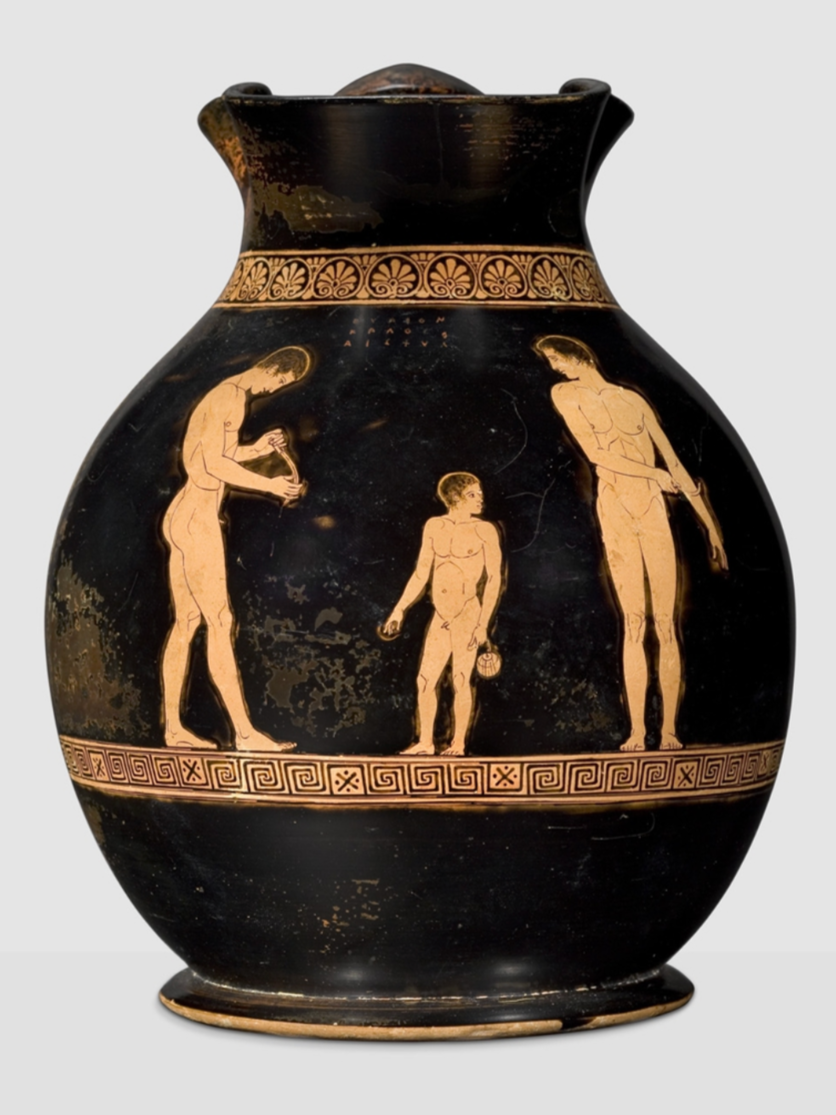
Wine jug (chous) with two athletes holding strigils 475-425 BCE
Credited to the Achilles Painter
Athens
Red-figure technique
Cleaning their bodies after athletic training, the two athletes framing the scene hold strigils (cleaning devices) which scrape off accumulated sweat, dirt, and oil. The figure in the middle, either a boy or slave, holds a strigil and an oil container, instruments used by athletes in the gymnasium. The three figures are naked showing off their musculature.
Basel, Antikenmuseum und Sammlung Ludwig BS 485
Photo courtesy of Antikenmuseum und Sammlung Ludwig
Photos courtesy of The Getty Museum
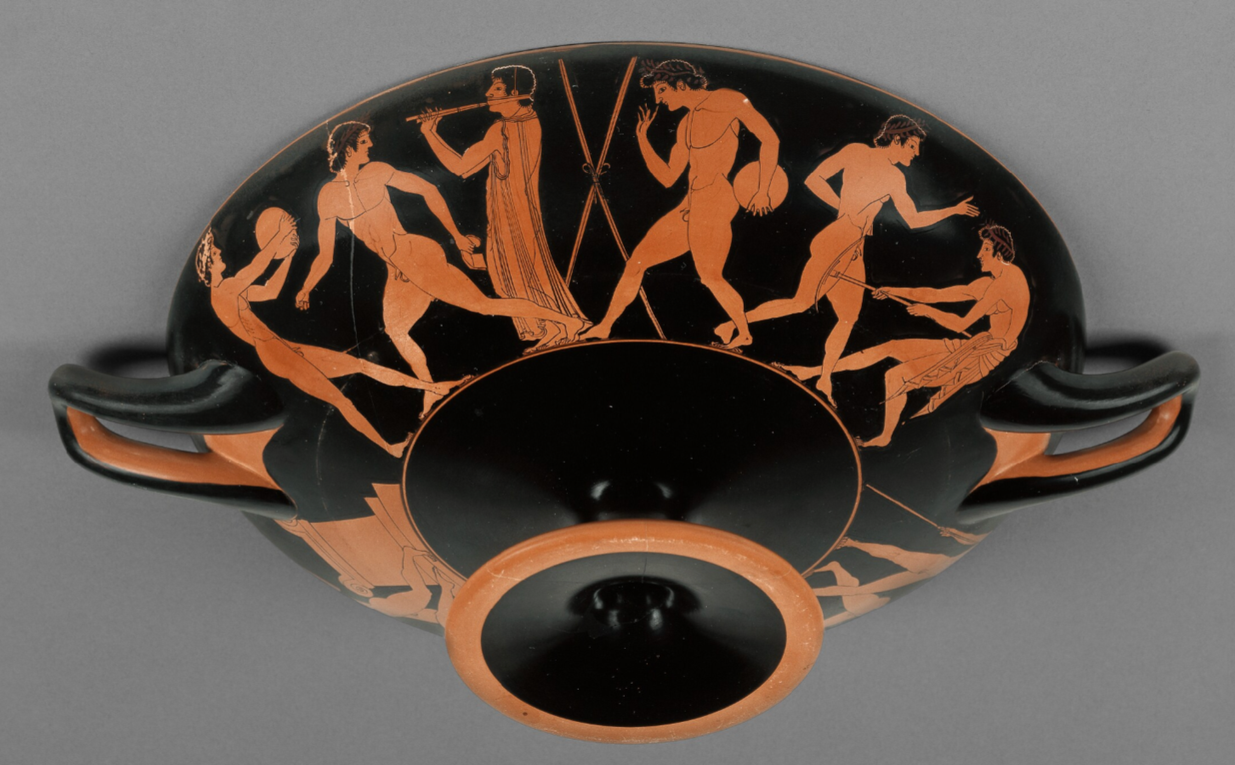
Photo courtesy of The British Museum
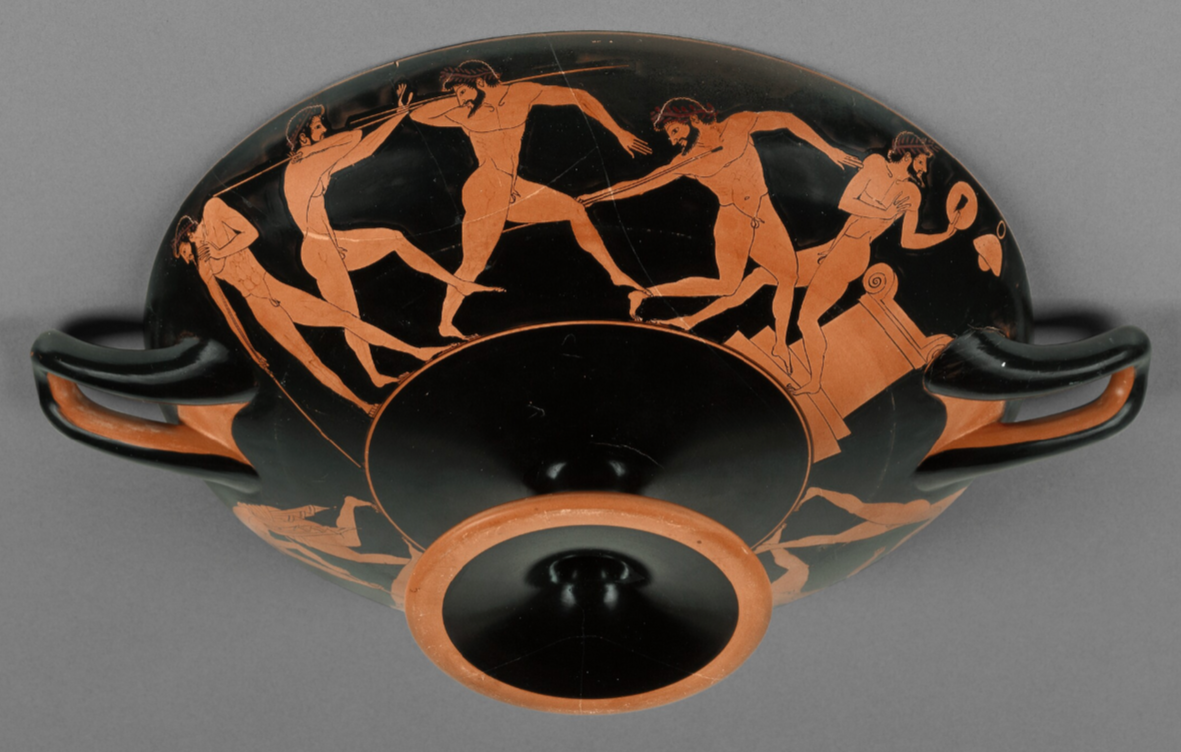
Kylix (wine cup) with mature and young athletes, 510-500 BCE
Credited to the Carpenter Painter
Attica (district encompassing Athens)
Red-figure technique
Depicting mature athletes on one side and young athletes on the other, the drinker could compare and contrast two types of athletics with the mature (left) showing off their skill and the young (right) showing off their bodies. The mature athletes, identified by their beards, are in a tense and dynamic moment of training whereas the youth are relaxed and convivial.
Getty Museum 85.AE.25
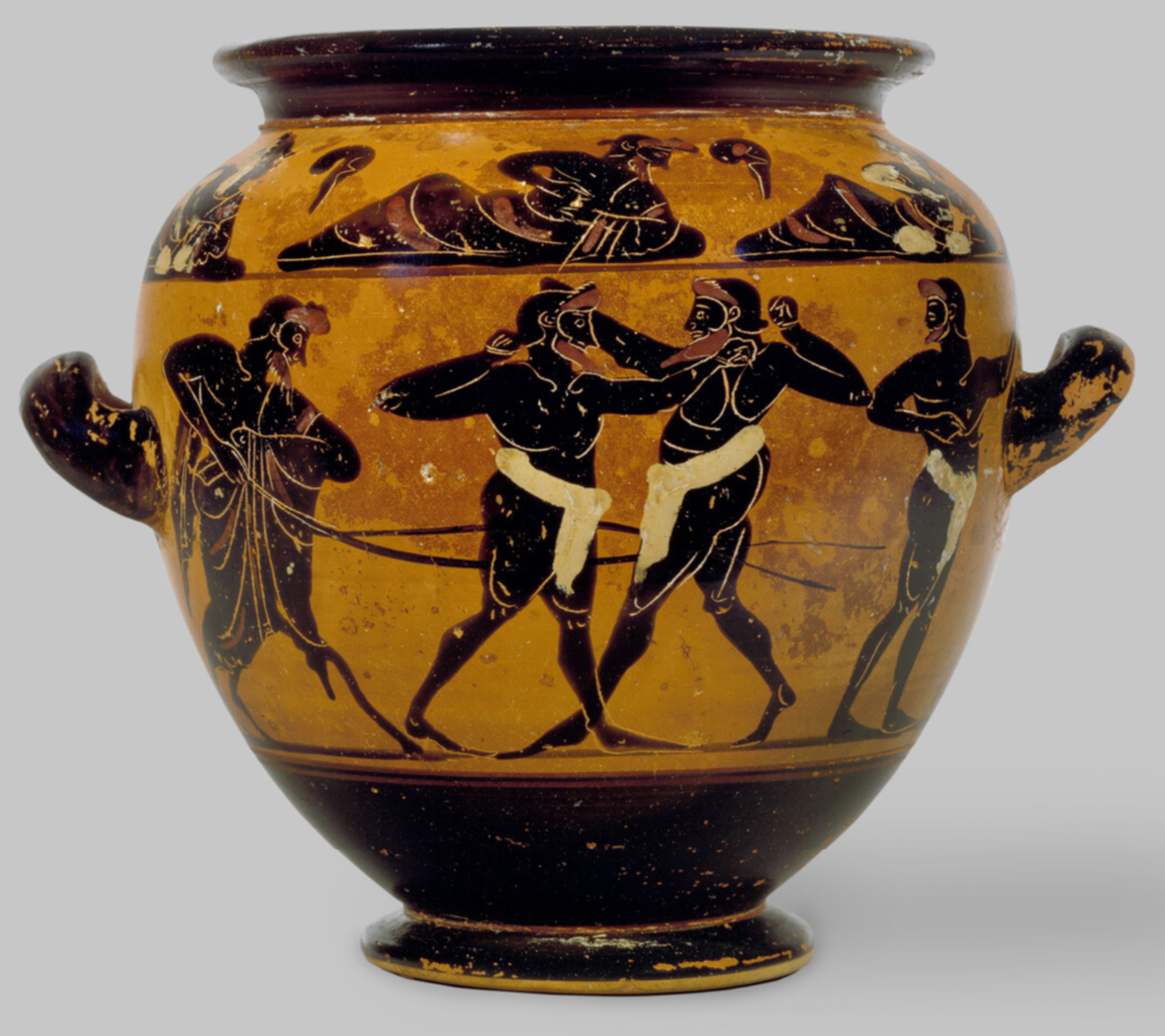
Photo courtesy of The Ashmolean Museum
-
This Attic red-figure chous (wine jug) is dated from 450 to 440 BCE and attributed to the Achilles Painter by John Beazley. It is currently located at Basel, Antikenmuseum und Sammlung Ludwig and was acquired via donation in 1982 by Fritz Bernheim; the object number is BS 485. The chous is 23.1 cm in height. The chous depicts two nude athletes holding strigils, cleaning dirt, sweat, and oil off their bodies after practice. The figure on the left cleans the hollow of the strigil pushing out the accumulated debris; the figure on the right scrapes his left arm with the strigil. The athletes stand on either side of a nude child or slave holding an aryballos and what looks to be a strigil. Considering the body language of the two athletes, they frame the middle figure thereby directing the viewer’s attention to the center despite this being the smallest person. Emphasising the middle figure is notable as it not only draws attention to the smallest person but also the person with the least amount of status as they are either a child or slave. Even if the child/slave is in the center, the musculature and face detailing privilege the athletes who are rendered in accordance with ancient Greek aesthetic ideals. The iconography suggests the middle figure is a slave working in the gymnasium (palaistra), helping the athletes, and explains his less-idealized features (as opposed to the athletes), categorizing him as other (non-Greek). Showing a moment of calm and serenity, the scene is relaxed offering athletes a respite from their training. The scene is bordered by a palmette pattern on top and a meander pattern on the bottom with a simple line on either side of the scene. On the opposite side of the scene, underneath the handle, is a palmette motif. The chous is inscribed between the two athletes with a dedication to Euaion, son of the poet Aeschylus, who is praised for his beauty (“Euaion kalos Aischylo” or “Euaion the son of Aeschylus is lovely”). The inscription legitimizes Euaion’s lineage as an Athenian with civic rights who conforms to Greek aesthetic ideals of kalos (beauty). No such claim or privilege awaits the middle figure who would have been excluded from civic life and political rights.
_
Antikenmuseum Basel. n.d. “Wine jug depicting two athletes.” Accessed March 20, 2026. https://antikenmuseumbasel.zetcom.net/en/collection/item/72921/.
Beazley Archive Pottery Database. n.d. “275428, ATHENIAN, Basel, Antikenmuseum und Sammlung Ludwig, BS485.” Accessed March 20, 2026.https://www.carc.ox.ac.uk/XDB/ASP/recordDetails.aspid{937721A8A704417CA9491CE593EBB299}&noResults=6&recordCount=5&databaseID{12FC52A70E324A819FFAC8C6CF430677}&search{AND}%20%20[Collection%20Name]%20Basel,%20Antikenmuseum%20und%20Sammlung%20Ludwig%20{AND}%20%20[Artist%20Name]%20ACHILLES%20P.
Neils, Jenifer. “Picturing Victory: Representation of Sport in Ancient Greek Art.” In A Companion to Sport and Spectacle in Greek and Roman Antiquity, edited by Paul Christesen and Donald Kyle. West Sussex: Wiley-Blackwell, 2014.
-
This Attic red-figure kylix is dated from 510 to 500 BCE and attributed to the Carpenter Painter by Dietrich von Bothmer. It is currently located at the Getty Museum and was acquired in 1985 through sale; the object number is 85.AE.25. The kylix is 11 × 38.1 × 33.5 cm. Side A depicts five athletes, four of them are engaged in the different stages of throwing a javelin, and the fifth holds a discus with an owl motif. The athletes on this side are all bearded and garlanded showing age and boasting triumph. Side B also depicts five athletes with an additional sixth figure of an aulous player. Two crossed javelins, in the shape of an X, break up the composition into two equal halves with three figures on either side. There is a suspended aryballos and sponge in the background alluding to a preparation scene versus a scene of strict action like on Side A. The athletes are youthful and garlanded: one holds a pick; two hold diskoboloi beginning their swings; one prepares to jump with halteres (weights); and one has a javelin. The athletes are loosely engaged in their athletic activity but do not share the same seriousness, rhythm, or motion as the older athletes on Side A. The Side A athletes show off their skill whereas the Side B athletes show off their beauty and bodies. In the tondo of the kylix, there is a courting scene with a youth seated on a block pulling a man with a staff down for a kiss. Both figures are garlanded and clothed and their legs are intertwined. The tondo bridges the gap between both sides of the kylix depicting an older man, as seen on Side A with a youth, as seen on Side B. The tondo points to the prevalence of pederastic relationships in ancient Greece wherein older men provided mentoring, education, and sex to youthful boys. The gymnasium facilitated these relationships where these two groups met to socialize, educate, and train. Considering the shape and iconography, this kylix likely would have been used in symposia with drinkers gazing upon these scenes and reinforcing the normalcy of these pederastic relationships.
_
Beazley Archive Pottery Database. n.d. “31619, ATHENIAN, Malibu (CA), The J. Paul Getty Museum, 85.AE.25.” Accessed March 20, 2026. https://www.carc.ox.ac.uk/XDB/ASP/recordDetails.asp?id={BCD1F254-C130-4E7A899AD9A6B6A586A4}&noResults=1&recordCount=1&databaseID{12FC52A70E324A819FFAC8C6CF430677}&search{AND}%20%20[Artist%20Name]%20CARPENTER%20P%20{AND}%20%20[Collection%20Name]%20Malibu%20(CA),%20The%20J.%20Paul%20Getty%20Museum.
Haworth, Marina. “Introduction.” The Meaning of Athletic Imagery on Red-Figure Athenian Symposium Pottery. Dissertation. ProQuest Dissertations & Theses Global. 2023. 1-27. https://www.proquest.com/docview/2892623279?sourcetype=Dissertations%20&%20Theses.
Osborne, Robin. “Changing in the Gymnasium." In The Transformation of Athens: Painted Pottery and the Creation of Classical Greece. Princeton: Princeton University Press, 2018.
The Getty. n.d. “Attic Red-Figure Kylix.” Accessed March 20, 2026. https://www.getty.edu/art/collection/object/103VNT?canvas=b0d04aba-ab4d-4e56-9ad8-f543bf8bb60b.
-
This Attic red-figure cup is dated to 480 BCE and is attributed to the Douris Painter by signature. It is currently located at the British Museum and was acquired in 1867 with a find spot in Vulci; the object number is 0508.1060. Its previous owners were Louis Duc de Blacas d’Aulps and Lucien Bonaparte. The cup is 10.2 cm in height, 34.5 cm in width, and 26.8 cm in depth. Side A depicts five figures: two sets of boxers with a trainer in between them. The boxers are rendered from different angles showing the artist’s understanding of the body from multiple angles. The second boxer from the left of the composition has a foreshortened right foot showing an experimentation with pictorial space and depth. The boxing pair on the left almost mirror each other in positioning with one arm outstretched and the other poised to strike; they both have thongs around their wrists. Identified by his himation and forked stick in his right hand, the trainer gestures with his left hand to the pair of boxers on the right side of the composition. On the right, the pair of boxers do not mirror one another but rather the left athlete is succeeding over the figure on the right. To the right of the trainer, the athlete stands over his opponent who is on his left knee with a unique positioning of a frontal face and torso. With his index finger raised, the loser surrenders to his opponent. Side B also depicts five figures, two sets of athletes on either side of a trainer. The boxing pair on the left side is similar to the boxing pair on the reverse side. The athlete second to the left on the composition has a foreshortened right foot like his counterpart on Side A. In right profile, the clothed trainer holds a forked stick and looks behind his right shoulder to the pair on the left. The athlete pair on the right of the composition are relaxed and hold thongs; they are not engaged in immediate training or athletics. The tondo shows a naked athlete bending towards an altar holding a thong or himantes, alluding to this cup having a religious context despite being an athletic scene in the mortal world. By honouring and thanking the gods, athletics transcends beauty and entertainment.
_
Beazley Archive Pottery Database. n.d. “205073, ATHENIAN, London, British Museum, London, British Museum, London, British Museum, 1867,0508.1060.” Accessed March 20, 2026. https://www.carc.ox.ac.uk/XDB/ASP/recordDetails.asp?id={8D83D3B6-11B9-4EE3-BA563809026852C0}&noResults=21&recordCount=2&databaseID={12FC52A7-0E32-4A81-9FFA-C8C6CF430677}&search={AND}%20%20[Collection%20Name]%20London,%20British%20Museum%20{AND}%20%20[Artist%20Name]%20DOURIS.
British Museum. n.d. “Cup.” Accessed March 20, 2026. https://www.britishmuseum.org/collection/object/G_1867-0508-1060.
Neils, Jenifer. “Picturing Victory: Representation of Sport in Ancient Greek Art.” In A Companion to Sport and Spectacle in Greek and Roman Antiquity, edited by Paul Christesen and Donald Kyle. West Sussex: Wiley-Blackwell, 2014.
-
This Attic black-figure stamnos is dated from 510 to 500 BCE and attributed to the Perizoma Group by John Beazley and the Michigan Painter by Barbara Philippaki. It is currently located in the Ashmolean Museum and was previously owned by Edward Spencer-Churchill in his private collection in Northwick; the object number is AN1965.97. The stamnos is 17.4 cm in height, 23 cm in width, and 14 cm in diameter. On Side A, on the very left of the composition, is a bearded judge wearing a himation and holding a staff; he looks to the boxing pair to the right. The boxing pair of athletes are bearded and wear perizoma. To the right of the boxing pair is another athlete, perhaps a boxer, who is watching the athletes engaged in the battle. On the shoulder of the stamnos are reclining male and female symposiasts pointing to the vase’s use in symposia. Food and clothes are suspended on the back wall. This serves as a meta commentary on symposiasts gazing upon images of athletes in the scene and in symposia itself. Side B depicts three bearded men running in sequence wearing perizoma. Male and female symposiasts also lounge on the shoulder with food and clothes on the back wall. The athletes’ bodies are rendered similarly, regardless of the sport they are engaged in, which was uncommon as artists tended to depict heavy (combat) and light (racing) sports differently. This contrast highlights the varying bodily requirements for different athletics. Depicting the athletes in perizoma and rendering them in a similar body type might allude to this vase being made for export outside of Athens due to non-standard Athenian imagery. Adapting forms and iconography would have shown that the Perizoma Group is in tune with export markets and consumers. While this iconography differs from classical Athenian imagery, it is in keeping with the Perizoma Group style which depicted athletes in a white loincloth bucking the tradition of showing off the beautiful nude athlete body.
_
Ashmolean Museum. n.d. “Attic black-figure pottery stamnos depicting an athletics scene.” Accessed March 20, 2026. https://www.ashmolean.org/collections-online#/item/ash-object-471712.
Beazley Archive Pottery Database. n.d. “301908, ATHENIAN, Oxford, Ashmolean Museum, Northwick, private, Spencer-Churchill, 1965.97.” Accessed March 20, 2026. https://www.carc.ox.ac.uk/XDB/ASP/recordDetails.asp?id={2AF9B2D3-A122-46F7-95B3-D2A0E40DFBB8}&noResults=2&recordCount=1&databaseID={12FC52A7-0E32-4A81-9FFA-C8C6CF430677}&search=%20{AND}%20%20[Collection%20Name]%20Oxford,%20Ashmolean%20Museum%20{AND}%20%20[Artist%20Name]%20PERIZOMA%20GROUP.
Lewis, Sian. “Athletics on Attic Pottery: Export and Imagery.” Paper presented at The World of Greek Vases Conference, Rome, Italy, January 2005.
Neils, Jenifer. “Picturing Victory: Representation of Sport in Ancient Greek Art.” In A Companion to Sport and Spectacle in Greek and Roman Antiquity, edited by Paul Christesen and Donald Kyle. West Sussex: Wiley-Blackwell, 2014.
Smith, Tyler Jo. 28.2 “Athlete, Sport, and Games.” In A Companion to Greek Art, edited by Tyler Jo Smith and Dimitris Plantzos. Oxford: Wiley-Blackwell 2012.
Stamnos (serving/storage jar) with athletes in loinclothes, 550-500 BCE
Credited to the Perizoma Group (artist guild)
Attica (district encompassing Athens)
Black-figure technique
Rather than the usual depiction of ideal youthful athletes showing off their beautiful bodies, these athletes are bearded and wear perizoma (loincloths). The athletes are engaged in different athletics, including boxing and running, though their bodies are rendered similarly with fuller figures. Added red and white paint is added to the athletes’ hair and loincloth drawing attention to their face and bodies.
Ashmolean Museum AN1965.97
Want to learn more? View the complete catalogue record below.
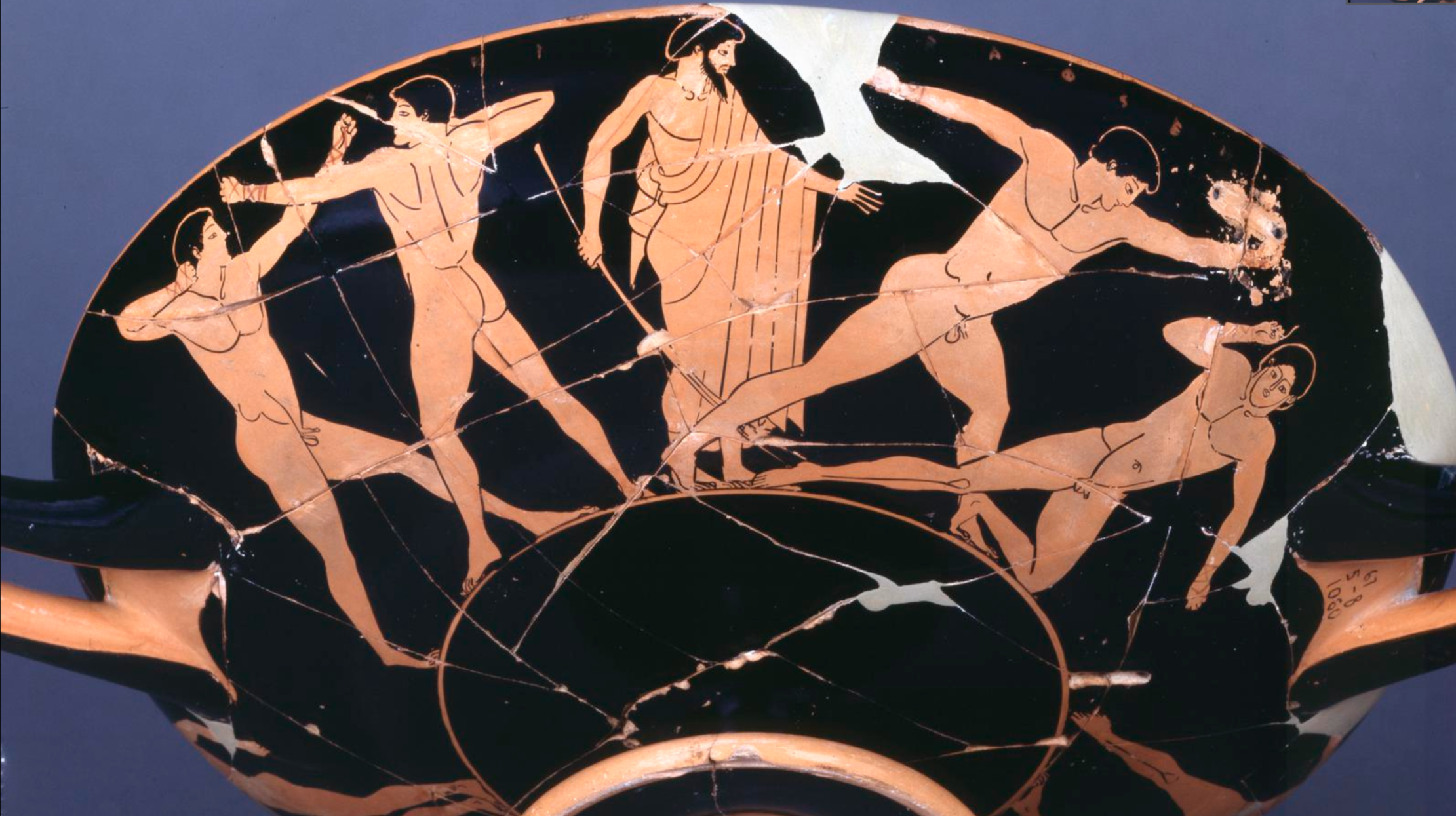
Cup with two athletic scenes, 480 BCE
Signed by the Douris Painter
Attica (district encompassing Athens)
Red-figure technique
Depicting four pairs of athletes and two trainers, this cup shows youthful boxers from a variety of angles. The user of the cup could gaze upon the beautiful athletic form shown from a multitude of perspectives. The athlete on the far right surrenders to his boxing opponent and faces the viewer, a unique occurrence in ancient Greek pottery.
British Museum 1867, 0508.1060